The power Brief – Your Briefing on the energy transition.
Powering Europe together
Why EU-Cooperation is the backbone of the electricity system
As Transmission System Operators (TSOs), we see cross-border cooperation not as an option, but as part of our DNA. In a power system shaped by renewables, electrification and geopolitical uncertainty, coordinated European planning, operation and market coupling are essential to keep electricity secure, affordable and on track towards climate neutrality.
Pioneers of cross‑border cooperation
At a glance: Key building blocks of European cooperation
- 1929: EUs first commercial 220 kV line – linking central Germany and Austria.
- 1958: The “Star of Laufenburg” synchronises the 220 kV grids of Switzerland, Germany and France.
- 1999: UCTE and ETSO associations; EU TSOs coordinate technical and market rules.
- 2008: ENTSO‑E is established to coordinate European TSOs on grids, market rules and operation.
- 2008: Coreso and TSCNET; As first Regional Security Coordination Centres.
- 2014: SDAC launches for the EU’s day-ahead market coupling; 2018: SIDC follows for intraday.
- 2015: Central Western Europe flow-based market coupling improves the use of cross-border capacity and is later extended to the wider Core region and other EU regions.
- 2020–2022: EU balancing platforms go live under the Network Codes, building on earlier TSO-led initiatives such as imbalance netting/IGCC.
- Today and beyond: European cooperation continues to evolve, as TSOs together with authorities, partners and stakeholders further refine the methods and rules for grid planning, system operation and market coupling.
Today’s TSO cooperation is governed by extensive EU rules – but core initiatives to strengthen system security and reduce costs through synergies and market development were launched proactively by TSOs before becoming legally binding.
Making electricity affordable through market coupling
A fully interconnected European electricity market ensures that the most cost-efficient power plants are dispatched across borders. Through EU market coupling, electricity flows to where it is needed most, allowing the cheapest available generation to cover demand. As renewable energy sources top the merit order, abundant wind or solar power can replace the more expensive fossil fuel generation elsewhere. This lowers prices and reduces the EU's dependence on fossil fuel imports.
Today, the Single Day-Ahead Coupling (SDAC) project efficiently allocates cross-border transmission capacity across 27 countries by coupling wholesale electricity markets through a common algorithm operated by power exchanges acting as Nominated Electricity Market Operators (NEMOs). In 2025 alone, SDAC generated €32 billion in socio‑economic welfare gains. After day-ahead closure, the Single Intraday Coupling (SIDC) helps market participants better manage forecast errors. Recent improvements have increased flexibility: the intraday cross-zonal gate closure time was reduced from 60 to 30 minutes before delivery, and the cross-border trading time resolution was shortened from 60 to 15 minutes, helping the market better follow actual generation and consumption patterns. These were important steps towards integrating increasingly volatile renewable energy generation into the market and e.g. linking the wind-dominated north of Europe with solar generation in the south, or storage in the Alps.
The value of market coupling becomes most visible when it fails. For the delivery day of 26 June 2024, a software issue (in an otherwise highly reliable system) led to a partial decoupling of EPEX Spot. Consequently, cross-border capacities were not included in the EPEX day-ahead price calculation, leading to prices above €2,300/MWh at 6 a.m. in Germany on a normal day without scarcity — roughly 20 times the level of the previous day. This showed that European market coupling is not theoretical, but essential for price stability and affordability.
We are motivated to continuously improve EU market coupling and the optimal use of the existing grid, together with power exchanges, authorities and market participants. Nevertheless, additional internal and cross-border grid investments are still necessary, and operational limits must be respected.
Keeping Europe at 50 Hertz – Together
Frequency control is what keeps our power system stable. And keeping the European power system stable at 50 Hz is a core task of TSOs. We must continuously balance supply and demand and be ready to respond to forecast errors or sudden outages, for example the loss of a large power plant or interconnector.


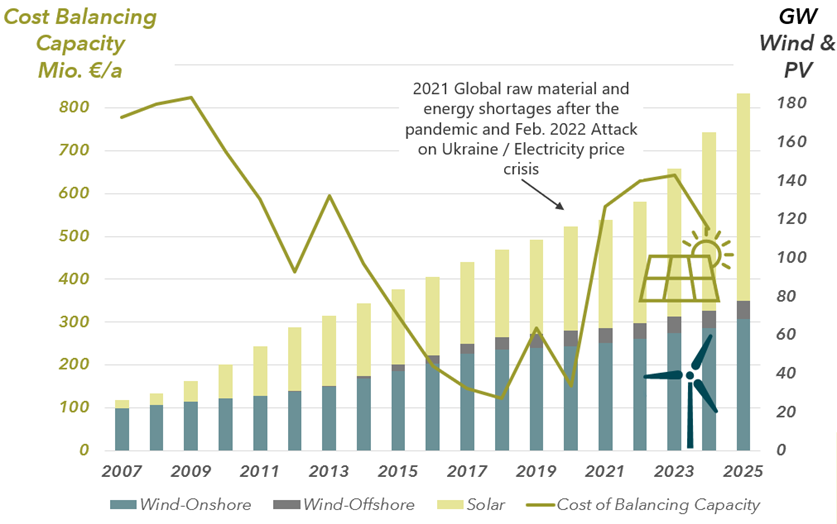
In the past, frequency control and balancing were managed largely at national level. In a power system increasingly shaped by volatile renewable generation, this would no longer be secure or affordable. With European balancing platforms, TSOs have established a truly European approach to system balancing. The ongoing improvement of common rules and these platforms enable the exchange of balancing energy across borders in real time, increasing competition, reducing costs and improving operational security. Despite a system that is becoming ever more volatile, balancing power costs in Germany are lower today than they were 15–20 years ago.
In 2025, European balancing platforms delivered €1.2 billion in welfare gains, despite the continued addition of new TSOs – for example, RTE, the French TSO, joined the MARI platform most recently.
At TransnetBW, we are proud that all European TSOs have appointed us as the common service provider to operate key platforms such as IGCC and PICASSO on their behalf. We have been operating the International Grid Control Cooperation (IGCC) platform since 2011. Since then, it has generated more than €3.5 billion welfare, while common project costs last year amounted to only around €100,000.
European cooperation beyond real‑time operation
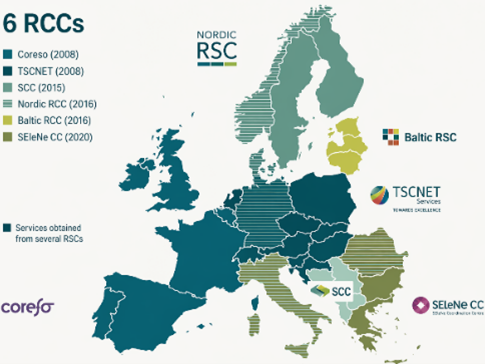
Every TSO remains fully responsible for secure real-time operation in its control area. In today’s highly interconnected power system, however, this is only possible with strong upstream European coordination. Regional Coordination Centres (RCCs) support TSOs with e.g. coordinated capacity calculations and security analyses. Developed under ENTSO‑E and anchored in the Network Codes, these services combine clear national responsibility with effective European cooperation.

Making the best possible use of existing grid capacity and enabling electricity trading to take place close to real time are central to achieving affordability and integrating renewables. However, this can only work if secure system operation is guaranteed at all times. As trading moves closer to real time and capacities are used more intensively, operational feasibility must always be respected — including calculation times, redispatch needs, multi-TSO coordination and EU-wide IT development.
The need for strong cross-border coordination was also highlighted after the 28 April 2025 blackout in Spain and Portugal. ENTSO‑E’s investigation reports describe a complex sequence of events that ultimately led to the separation of the Iberian Peninsula from the rest of the continental European system. While European real-time coordination brings significant organisational and process challenges, a tightly interconnected European system is demonstrably safer than isolated systems or networks linked by only a few interconnectors.
Planning Europe’s grid – A shared endeavour
European grid planning has fundamentally evolved: what was once largely national is now coordinated at European level via ENTSO-E. Since the first Ten-Year Network Development Plan (TYNDP) in 2010, around 16,000 km of lines have been built. By 2045, a further 100,000 km of new transmission lines are planned.
The current TYNDP addresses the need for around 108 GW of additional interconnector capacity, including 20 GW offshore hybrid interconnections. The study highlights that every euro invested in the TYNDP translates into around two euros of system cost savings by 2040. Financing the approximately €800 billion expansion of the EU's transmission grid until 2050 will be challenging, and new financing tools will be required. However, not investing would be far more expensive (€49 billion/year) – for consumers, industry and society.
ENTSO‑E’s joint network planning has evolved considerably, enabling stronger integration across borders, sectors, and regions, while including new technologies. By linking national grid development plans (NDPs) with a European-wide vision, it plays a key role in supporting the achievement of EU climate goals. However, when it comes to the projects, supply-chain constraints, permitting delays and financing conditions remain major obstacles. While planning is coordinated at EU level, grid investments will still need to be financed mainly through reliable national regulatory frameworks that need to leave room for national decision-making, as highlighted beside other points in our position on the European Grids Package.
Security of supply is European
Security of supply must be assessed at European level. Within ENTSO‑E, the European Resource Adequacy Assessment (ERAA) evaluates whether sufficient generation, storage and flexibility are available to meet the demand.
The ERAA 2025 projections show that Germany could face 20-31 hours of Loss of Load Expectation (LoLE) in 2030, and up to 97 hours in 2035 — far above the national reliability standard of 2.77 hours. The study underlines the urgent need for additional firm capacity and flexibility, not only in Germany but across Europe.
Still, European cooperation significantly reduces the need for purely national investment. Demand peaks differ across Europe: e.g. in 2024, Italy recorded its highest load on 19 July, while Germany’s peak load occurred on 15 January. Renewable generation patterns are also often complementary, with solar dominating in the south and wind in the north. Supporting each other within a connected system in Europe during periods of scarcity makes the system more efficient than building local power plants for the hour with the highest national consumption.
More Europe is therefore part of the solution — but not a one-size-fits-all approach. Although common European principles are important, capacity mechanisms that ensure additional reliable generation capacity is being built must still allow for subsidiarity and targeted national solutions. Different national energy pathways — ranging from Germany's transition model to France's plans for new nuclear capacity — necessitate distinct actions. What we need in Germany is addressed in the following THE POWER BRIEF.
Conclusion
European cooperation is both an opportunity and a necessity. Integrated markets coordinated system operation and joint planning enable Europe to decarbonise its electricity system securely and affordably. At the same time, a well‑designed framework of subsidiarity remains essential, allowing targeted and efficient national solutions to address local challenges.
Only by working together – as European TSOs, in close cooperation with regulators, ACER, policymakers and market participants – can Europe achieve a secure, competitive and sustainable energy system. European cooperation lies at the heart of the electricity system today and in the decades to come.
Your contacts

More about us
- Overview
Find out which topics TransnetBW is promoting in the field of energy policy.
- System security
System security is the foundation of the energy transition.
- Grid expansion
Well-developed networks for a successful energy transition.
- Market-design and flexibilities
Rethinking electricity market design – activating flexibilities.
- Regulation
Regulation for the energy transition.
- Downloads
Our statements, positions and other contributions.